

Selected fruit. Disciplined production.
The natural character of properly produced Ghanaian palm oil.
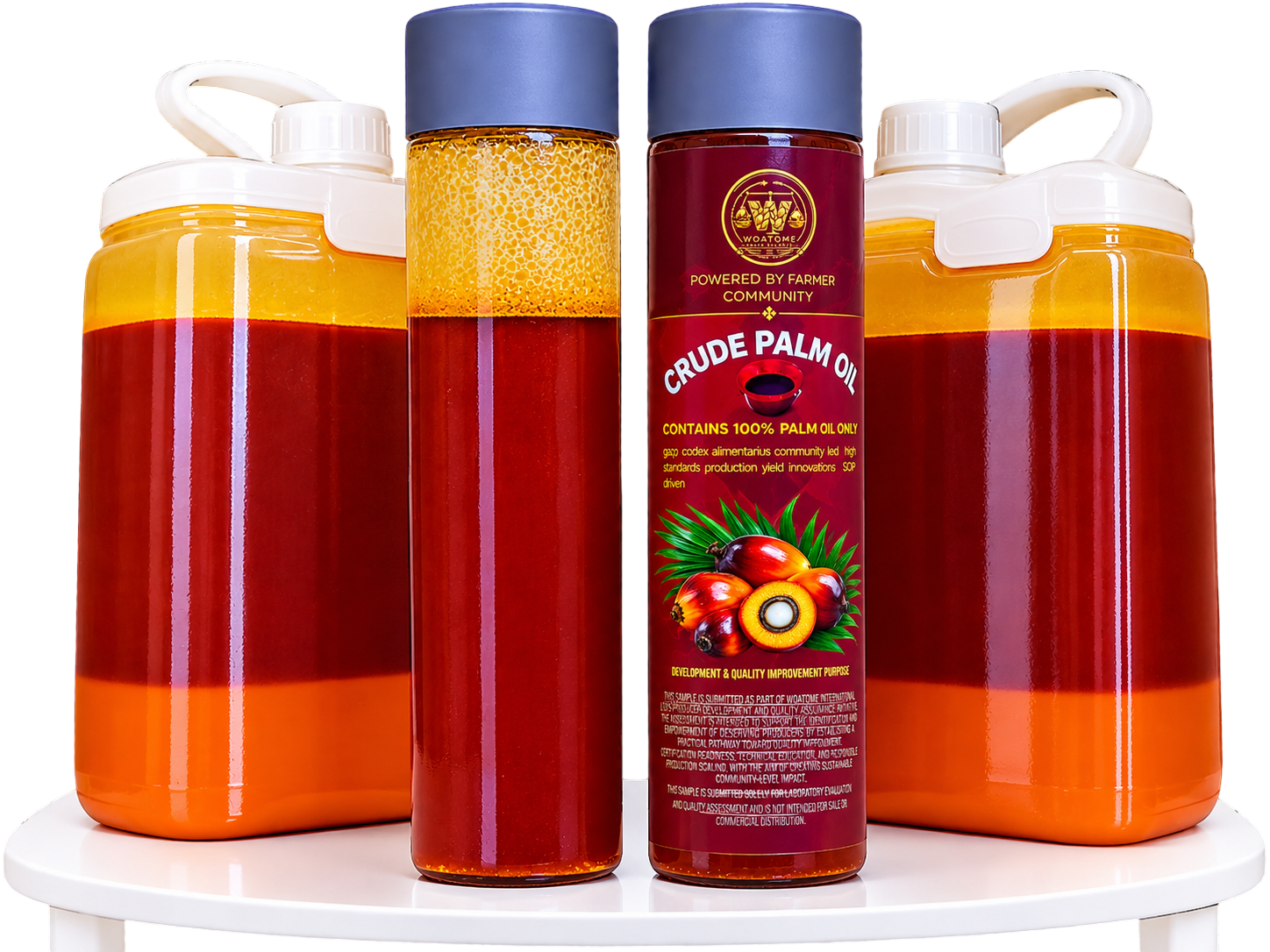
WOATOME CRUDE PALM OIL
PREMIUM GHANAIAN RED PALM OIL
QUALITY-LED , REGULATORY COMPLIANT PRODUCTION
LOCALLY BUILT INFRASTRUCTURE COOPERATIVE SOURCING SUITABLE FOR INTERNATIONAL COMMERCIAL SUPPLY
Woatome Crude Palm Oil is developed through a quality-led production model that brings together carefully sourced Fresh Fruit Bunches, capable Ghanaian processors, locally manufactured processing infrastructure and coordinated quality management.
Our approach recognises an important reality within Ghana's palm oil industry: meaningful production capability already exists across agricultural communities, semi-mechanised processing operations and local engineering workshops. The opportunity is not necessarily to replace these capabilities with a single large industrial factory. It is to organise, strengthen and standardise them into a dependable production system capable of serving increasingly demanding domestic and international markets.
Woatome therefore approaches crude palm oil as more than a commodity to be purchased and aggregated.
We focus on the conditions under which quality oil is produced.
This begins with the selection and handling of Fresh Fruit Bunches. It continues through timely processing, appropriate thermal treatment, digestion, extraction, clarification, moisture management and hygienic handling. It is supported by trained operators, defined operating procedures, batch documentation and quality verification.
Our long-term production model is based on a distributed network of standardised semi-mechanised processing units supported by organised agricultural sourcing and common quality-management requirements.
Rather than depending exclusively on one large industrial facility, Woatome can coordinate multiple production units operating under a shared commercial and production framework.
The result is a model designed to combine:
Ghanaian agricultural production.
Local engineering and machinery fabrication.
Semi-mechanised processing.
Operator training.
Common operating procedures.
Production supervision.
Batch accountability.
Quality verification.
Traceability.
Coordinated specialty and commercial supply.
We are not simply aggregating palm oil. We are organizing the infrastructure and production conditions required to produce it more consistently.
01. UNDERSTANDING CRUDE RED PALM OIL
Palm oil is extracted primarily from the fleshy mesocarp of the fruit of the oil palm tree, scientifically known as Elaeis guineensis.
Native to West Africa, the oil palm has long been an important agricultural crop throughout the region, supporting food production, rural livelihoods, trade and numerous downstream industries.
Crude red palm oil is particularly valued throughout West African cuisine for its distinctive red-orange color, characteristic aroma and contribution to the flavor of traditional dishes.
Its natural color comes primarily from carotenoid pigments, including beta-carotene and alpha-carotene.
Unlike highly refined palm oil, crude red palm oil retains much of the natural color and sensory character associated with the fruit.
It also contains naturally occurring minor components, including tocopherols and tocotrienols, alongside its characteristic fatty-acid composition.
Beyond its natural composition, crude red palm oil remains an important culinary ingredient.
Its color, aroma and flavor contribute to numerous regional dishes and food applications.
OUR FOCUS
Woatome concentrates on developing and supplying quality Ghanaian crude red palm oil through appropriate agricultural sourcing, disciplined production, effective clarification, controlled handling and accountable supply.
Our objective is to preserve the desirable natural characteristics of properly produced red palm oil while strengthening the systems responsible for producing and supplying it.
02. QUALITY BEGINS WITH THE FRUIT
NOT ALL PALM OIL BEGINS WITH THE SAME RAW MATERIAL.
The quality of crude palm oil is influenced significantly by the condition of the Fresh Fruit Bunches entering production.
Fruit maturity, harvesting practices, delays before processing and the condition of incoming material can influence extraction performance and finished-product characteristics.
For this reason, Woatome's quality philosophy begins before the oil is extracted.
We work towards establishing sourcing and receiving requirements that priorities:
Appropriately matured Fresh Fruit Bunches.
Inspection of incoming fruit.
Exclusion of unsuitable or excessively deteriorated material.
Appropriate harvesting and collection practices.
Reduced unnecessary delays before processing.
Clean handling and transportation.
Documented sourcing and production records.
We recognise that processing cannot fully compensate for poor-quality raw material.
Our objective is therefore to establish quality at the beginning of the production chain rather than attempting to correct deficiencies after the oil has already been produced.
THE PRINCIPLE IS SIMPLE:
Know the fruit before you evaluate the oil.
03. A DIFFERENT PRODUCTION MODEL
NOT ONE FACTORY. A COORDINATED PRODUCTION NETWORK.
Conventional industrial development often assumes that meaningful commercial supply requires one large, centrally located factory.
Woatome sees another opportunity.
Ghana already possesses a combination of capabilities that can form the foundation of a distributed processing infrastructure.
These include:
Agricultural communities with access to Fresh Fruit Bunches.
Independent and semi-mechanised palm oil processors.
Experienced production workers.
Mechanical and engineering artisans.
Local fabrication workshops capable of manufacturing and adapting agricultural processing equipment.
The challenge is not simply the absence of machinery or people capable of processing palm fruit.
The challenge is creating a system that connects these capabilities through common standards, training, supervision and commercial organisation.
Woatome's model is designed around that opportunity.
We aim to develop a network of properly configured semi-mechanised processing units capable of operating under shared requirements for:
Fruit sourcing.
Equipment configuration.
Operator training.
Production procedures.
Hygiene.
Quality management.
Batch identification.
Traceability.
Commercial product acceptance.
The objective is not to create several unrelated mills producing oil independently.
The objective is to create multiple production units functioning as part of one coordinated supply system.
04. GHANAIAN ENGINEERING & LOCALLY MANUFACTURED INFRASTRUCTURE
BUILDING WITH EXISTING GHANAIAN CAPABILITY.
One of the strengths of the Woatome model is the opportunity to work with Ghanaian engineering artisans and fabricators.
Rather than depending exclusively on imported industrial processing lines, suitable components of the processing infrastructure can be locally manufactured, assembled, adapted and maintained.
This creates an opportunity to develop a repeatable processing infrastructure based on locally available technical capability.
The objective is not simply to purchase machinery.
It is to develop a standardised processing system.
A Woatome processing unit can be designed around a common configuration that includes:
Production stageInfrastructureFruit receptionReceiving platform, weighing and inspectionThermal treatmentAppropriate fruit cooking or heat-treatment equipmentThreshingMechanical separation of fruit from bunchesDigestionMotorised fruit digestionExtractionMechanical oil extractionClarificationSeparation of oil, water and suspended solidsFinishingSettling, filtration and moisture managementQuality controlSampling and production recordsStorageFood-grade holding and controlled transfer
The exact engineering configuration must be validated according to the intended production capacity.
A machine advertised with a particular throughput does not automatically mean that the entire processing line can sustain that rate.
For example, a press may have sufficient extraction capacity while fruit preparation, digestion or clarification becomes the operational bottleneck.
For this reason, Woatome's infrastructure model is intended to evaluate processing units as complete production systems, not simply collections of individual machines.
05. THE WOATOME STANDARD PROCESSING UNIT
THE MACHINES CREATE CAPACITY. THE SYSTEM CREATES DEPENDABILITY.
The long-term objective is to establish a repeatable standard that participating processing units can follow.
This standard is not limited to machinery.
It includes the entire operating environment.
ENGINEERING REQUIREMENTS
Defined equipment and infrastructure requirements appropriate for the intended production capacity.
FRESH FRUIT BUNCH ACCEPTANCE
Common requirements governing fruit maturity, condition and acceptance.
OPERATOR TRAINING
Training in equipment operation, processing procedures, hygiene and production documentation.
STANDARD OPERATING PROCEDURES
Defined procedures covering critical production activities.
HYGIENE MANAGEMENT
Requirements supporting clean handling, equipment maintenance and appropriate production environments.
QUALITY MANAGEMENT
Sampling, inspection and agreed product acceptance procedures.
BATCH IDENTIFICATION
A consistent system connecting production activities to finished-product batches.
TRACEABILITY
Records connecting agricultural sourcing, processing and finished-product supply.
COMMERCIAL ACCEPTANCE
Procedures for determining which production batches meet agreed requirements for aggregation and supply.
This is the foundation of the Woatome infrastructure model.
The physical machinery can be replicated.
The production system must also be replicated.
06. ARTISAN CHARACTER. PROFESSIONAL PRODUCTION.
THE NATURAL CHARACTER OF PALM OIL WITHOUT UNNECESSARY COMPROMISES.
Woatome values the distinctive sensory character associated with properly produced West African crude palm oil.
Our objective is not to remove that character in pursuit of maximum industrial standardisation.
At the same time, artisan production should not mean unstructured production.
We believe carefully organised semi-mechanised processing can preserve the desirable characteristics of crude red palm oil while improving consistency, accountability and commercial dependability.
Our approach seeks to preserve:
Natural red-orange colour.
Characteristic palm fruit aroma.
Authentic crude palm oil flavour.
Appropriate cleanliness and clarity.
Natural product character.
Greater consistency between batches.
The distinction is important.
We believe improved infrastructure should enhance quality.
It should not simply increase extraction volumes without regard to the condition of the finished product.
07. FROM FRESH FRUIT BUNCH TO FINISHED OIL
A MANAGED PRODUCTION SEQUENCE.
Woatome's production framework follows a coordinated sequence designed to protect raw-material quality and improve finished-product consistency.
STAGE 1 — FRUIT SOURCING
Identification and selection of suitable Fresh Fruit Bunches through participating producers and agricultural communities.
STAGE 2 — HARVESTING & RECEIVING
Collection, weighing, inspection and documentation of incoming fruit.
STAGE 3 — THERMAL FRUIT TREATMENT
Appropriate controlled heat treatment to prepare the fruit for subsequent processing.
STAGE 4 — THRESHING
Mechanical separation of individual fruits from the bunches.
STAGE 5 — DIGESTION
Processing of the fruit mesocarp to facilitate oil release.
STAGE 6 — EXTRACTION
Mechanical extraction of crude palm oil from processed fruit material.
STAGE 7 — CLARIFICATION
Separation of oil from water and suspended solids.
STAGE 8 — MOISTURE MANAGEMENT & FINISHING
Appropriate management of residual moisture and product preparation for storage.
STAGE 9 — QUALITY INSPECTION
Assessment of agreed physical and analytical product parameters.
STAGE 10 — PACKAGING & STORAGE
Food-grade packaging and appropriate storage before distribution or export.
Processing conditions are established according to the equipment configuration, production arrangement and agreed finished-product requirements.
08. AGRICULTURAL, FOOD-SAFETY & QUALITY MANAGEMENT
QUALITY MUST BE PART OF PRODUCTION, NOT AN INSPECTION AT THE END.
Woatome's production network is developed around recognised agricultural and food-safety principles.
These principles inform how participating producers:
Source fruit.
Handle agricultural materials.
Operate processing equipment.
Maintain hygienic production conditions.
Manage potential contamination risks.
Document production.
Handle finished products.
Our framework incorporates principles associated with:
GOOD AGRICULTURAL AND COLLECTION PRACTICES
Applied to fruit sourcing, harvesting, collection and post-harvest handling.
CODEX FOOD-HYGIENE PRINCIPLES
Used to inform hygienic handling and contamination prevention.
HACCP-BASED PREVENTIVE THINKING
Applied as a framework for identifying and managing relevant production hazards.
GOOD MANUFACTURING PRACTICES
Supporting equipment hygiene, personnel practices and production consistency.
APPLICABLE GHANAIAN FOOD REGULATORY REQUIREMENTS
Relevant regulatory requirements inform product development, manufacturing, packaging, labelling and market distribution.
The purpose is to build quality management into the production process.
Quality should not begin when the buyer asks for a Certificate of Analysis.
09. THE WOATOME QUALITY DIFFERENCE
PREMIUM BY PRODUCTION DISCIPLINE. NOT BY CLAIM ALONE.
Woatome's premium positioning is based on the way the product is sourced, produced, managed and verified.
We do not intend to compete solely by offering the lowest possible price.
We also do not believe that maximum extraction should automatically be the primary objective of production.
Our focus is on five core areas.
1. SELECTED RAW MATERIALS
Appropriate Fresh Fruit Bunch maturity and condition are central to production quality.
2. PROCESSING TIMELINESS
Harvesting, collection and processing are organised to reduce unnecessary deterioration.
3. CONTROLLED EXTRACTION
Appropriate processing conditions are used to support effective extraction and desirable finished-product characteristics.
4. EFFECTIVE CLARIFICATION
Oil is managed through appropriate separation of water and suspended impurities.
5. PRODUCT INTEGRITY
We do not rely on artificial colouring or unnecessary additives to create the natural appearance and character of properly produced red palm oil.
Our objective is to preserve what good palm fruit naturally offers.
10. COOPERATIVE SOURCING & DISTRIBUTED PRODUCTION
ORGANISING EXISTING CAPACITY INTO ONE COMMERCIAL SYSTEM.
Woatome's model recognises that commercial production capacity does not necessarily need to exist in one location.
A network of appropriately configured processing units can collectively provide meaningful production capacity.
Participating production units can operate closer to agricultural sourcing communities while being connected through common:
Operating procedures.
Training requirements.
Quality requirements.
Batch documentation.
Traceability systems.
Commercial supply arrangements.
This structure allows Woatome to coordinate distributed capacity while maintaining production-level visibility.
Our network model can incorporate:
LOCAL ENGINEERING
Ghanaian fabricators manufacture, adapt and maintain appropriate processing infrastructure.
ORGANISED AGRICULTURAL SOURCING
Collection structures help coordinate Fresh Fruit Bunch availability.
STANDARDISED PRODUCTION
Participating units operate according to agreed procedures.
TRAINED OPERATORS
Production personnel receive training relevant to equipment operation and quality requirements.
QUALITY SUPERVISION
Production activities are supported by inspection, sampling and agreed acceptance procedures.
COORDINATED COMMERCIAL SUPPLY
Accepted production can be aggregated for specialty and larger commercial procurement.
11. INDICATIVE INITIAL PRODUCTION CAPACITY
APPROXIMATELY 600 METRIC TONNES OF ANNUAL COORDINATED SUPPLY.
Woatome's initial network planning is being developed around an indicative annual crude palm oil supply target of approximately:
600 METRIC TONNES
This target does not necessarily require a large industrial processing complex.
For infrastructure planning purposes, a relatively small network of properly configured semi-mechanised processing units could theoretically support this production target.
An illustrative configuration would involve approximately:
FIVE STANDARDISED PROCESSING UNITS
Each designed around a nominal planning capacity of approximately:
500 KG OF FRESH FRUIT BUNCHES PER HOUR
Assuming an illustrative operating schedule of:
6 processing hours per day.
20 operating days per month.
12 months of planned production.
One processing unit could theoretically handle approximately:
720 METRIC TONNES OF FFB PER YEAR
Five processing units could theoretically provide capacity for:
3,600 METRIC TONNES OF FFB PER YEAR
Actual crude palm oil production depends on factors including:
Fruit characteristics.
Actual oil content.
Extraction efficiency.
Equipment performance.
Operator performance.
Downtime.
Maintenance.
Seasonal fruit availability.
Finished-product quality requirements.
Using an illustrative planning range of approximately 18–20% oil recovery, 3,600 tonnes of FFB could theoretically produce:
Illustrative recoveryPotential CPO18%648 MT19%684 MT20%720 MT
This provides a planning buffer above the initial 600 MT coordinated supply target.
These figures are planning estimates.
They are not guaranteed production output.
Actual throughput and recovery must be established through equipment commissioning, production trials and validated operational performance.
12. VALIDATE. STANDARDISE. REPLICATE.
A REPLICABLE INFRASTRUCTURE MODEL.
Woatome's preferred development pathway is based on progressive validation.
PHASE ONE — VALIDATE
Develop and commission a reference processing configuration.
Validate:
Actual FFB throughput.
Production bottlenecks.
Oil recovery.
Labour requirements.
Energy requirements.
Equipment performance.
Maintenance needs.
Finished-product quality.
PHASE TWO — STANDARDISE
Use the results to establish the Woatome Standard Processing Unit.
Define:
Engineering requirements.
Equipment configuration.
Operator training.
SOPs.
Hygiene requirements.
Quality controls.
Documentation systems.
PHASE THREE — REPLICATE
Expand the validated configuration across additional production locations.
THE DEVELOPMENT PRINCIPLE:
One validated unit.
A coordinated commercial network.
A replicable Ghanaian processing infrastructure.
As commercial demand grows, additional standardised units can be introduced.
Expansion therefore becomes a process of replicating proven infrastructure rather than repeatedly designing entirely new factories.
13. PRODUCT SPECIFICATIONS & QUALITY ASSURANCE
QUALITY THAT CAN BE ASSESSED, DOCUMENTED AND VERIFIED.
Woatome crude red palm oil is intended for buyers who value natural product characteristics alongside accountable production and measurable quality parameters.
ParameterProduct informationProductCrude Red Palm OilBotanical sourceElaeis guineensisCountry of originGhanaProduction modelQuality-managed semi-mechanised productionRaw materialSelected Fresh Fruit BunchesColourNatural red-orangeAromaCharacteristic of crude red palm oilFlavourCharacteristic palm fruit flavourAdditivesNo artificial colouring or unnecessary additivesFree fatty acidsBatch-tested against agreed specificationMoisture & impuritiesMonitored against agreed requirementsPeroxide valueAnalytically assessed where requiredPackagingFood-grade containers and bulk formatsTraceabilityProduction and batch documentationSupply formatSpecialty batches and coordinated commercial quantities
Supporting documentation may include:
Product specification sheets.
Batch identification records.
Certificate of Analysis where applicable.
Free fatty acid analysis.
Moisture and impurities analysis.
Peroxide value.
Relevant analytical testing.
Production records.
Sourcing records.
Applicable regulatory documentation.
Specific analytical values should be established through testing and agreed specifications rather than assumed across every production batch.
14. TRACEABILITY & PRODUCTION ACCOUNTABILITY
KNOW THE FRUIT. KNOW THE PROCESSOR. KNOW THE PRODUCT.
Woatome's distributed production model is designed to create greater visibility across the supply chain.
Our framework can incorporate records covering:
Producer identification.
Processing-unit identification.
Fresh Fruit Bunch sourcing.
Receiving dates.
Production dates.
Batch identification.
Quality inspection.
Packaging.
Storage.
Dispatch.
This creates a stronger connection between agricultural sourcing and finished-product supply.
For international buyers, this visibility can support greater commercial confidence and accountability.
15. SPECIALTY PRODUCTION & COMMERCIAL SUPPLY
TWO COMPLEMENTARY CHANNELS. ONE PRODUCTION PHILOSOPHY.
Woatome's commercial model recognises that specialty positioning and larger commercial supply can coexist.
A. WOATOME SPECIALTY CRUDE PALM OIL
The specialty channel focuses on carefully managed production, selected raw materials and controlled product availability.
It is intended for:
Premium food retailers.
Specialty distributors.
Restaurants.
Culinary businesses.
Buyers seeking distinctive Ghanaian red palm oil.
B. WOATOME COORDINATED COMMERCIAL SUPPLY
For larger requirements, Woatome can coordinate production across participating processing units operating under common quality-management requirements.
This channel is intended for:
Food manufacturers.
Commercial distributors.
Institutional buyers.
Agricultural ingredient importers.
Long-term procurement partners.
The difference between the channels is primarily one of:
Production allocation.
Availability.
Packaging.
Commercial volume.
Both are founded on the same principle:
Good raw materials. Disciplined production. Accountable supply.
16. WHY WOATOME?
WE ARE ORGANISING QUALITY, CAPACITY AND INFRASTRUCTURE.
Ghana already possesses many of the individual components required to produce quality crude palm oil.
There are:
Agricultural producers.
Fresh Fruit Bunches.
Experienced processors.
Semi-mechanised equipment.
Skilled production workers.
Engineering artisans.
Fabrication capability.
The opportunity is to connect these capabilities.
Woatome brings together:
AGRICULTURAL SOURCING
Organised access to suitable Fresh Fruit Bunches.
GHANAIAN ENGINEERING
Locally developed and maintainable processing infrastructure.
STANDARDISED PROCESSING
Repeatable production configurations.
OPERATOR TRAINING
Improved consistency in processing and documentation.
QUALITY MANAGEMENT
Defined requirements throughout the production process.
PRODUCTION SUPERVISION
Coordinated operational oversight.
TRACEABILITY
Records connecting fruit, production and finished-product batches.
COMMERCIAL AGGREGATION
The ability to coordinate accepted production into dependable supply.
MARKET ACCESS
Connecting Ghanaian production with specialty and international commercial markets.
Our ambition is to demonstrate that meaningful agricultural infrastructure does not always have to begin with one massive imported factory.
It can be developed through:
LOCAL ENGINEERING + STANDARDISATION + TRAINING + QUALITY MANAGEMENT + COORDINATED PRODUCTION
THE MACHINES CREATE CAPACITY. THE SYSTEM CREATES DEPENDABILITY.
17. BULK SUPPLY & COMMERCIAL ENQUIRIES
QUALITY-LED GHANAIAN RED PALM OIL FOR SPECIALTY AND COMMERCIAL PROCUREMENT.
Woatome welcomes enquiries from businesses and buyers seeking quality Ghanaian crude red palm oil.
Whether the requirement is for a carefully managed specialty allocation or coordinated commercial quantities, our model is designed to support structured procurement discussions.
Commercial arrangements may include:
Specialty production allocations.
Food-service packaging.
Retail packaging.
Bulk commercial quantities.
Seasonal procurement arrangements.
Buyer-specific specifications.
Long-term supply discussions.
TO BEGIN A PROCUREMENT DISCUSSION, PLEASE PROVIDE:
Company or buyer name.
Destination country.
Intended application.
Required quantity.
Preferred packaging format.
Expected procurement frequency.
Technical or analytical requirements.
Delivery location or destination port.
Preferred procurement period.
WOATOME MICRO INNOVATIONS
Ghana | United States
Agricultural Sourcing | Local Processing Infrastructure | Food Production | Quality Management | Cooperative Production | Commercial Supply
WE BELIEVE GOOD PALM OIL SHOULD NEVER HAVE TO COMPROMISE ITS QUALITY TO FIND ITS MARKET.
SELECTED FRUIT. LOCALLY BUILT INFRASTRUCTURE. DISCIPLINED PRODUCTION. DEPENDABLE SUPPLY.