

FOOD SAFETY
&
QUALITY ASSURANCE
Promoting structured handling, hygiene, post-harvest controls and quality management informed by internationally recognized food-safety principles.

We source from Dedicated Cooperative Farmer group using gacp haccp, then process at our codex facility by trained professionals.
FARM DIRECT HARVESTING
:
CODEX FACILITY PROCESSING
:
SUN DRIED
:
DEHUMIDIFIED TO 10% MC
:
CERTIFICATE OF ANALYSIS
:
SOP DRIVEN
:
GACP
:
WEST AFRICA
:
FARM DIRECT HARVESTING : CODEX FACILITY PROCESSING : SUN DRIED : DEHUMIDIFIED TO 10% MC : CERTIFICATE OF ANALYSIS : SOP DRIVEN : GACP : WEST AFRICA :

COLA NITIDA
WEST AFRICAN KOLA NUT SUPPLY
INTERNATIONALLY RECOGNISED CERTIFICATION
Working with NICERT Nigeria to develop a certification pathway for Ghanaian kola nuts, aligned with recognized international agricultural and food-safety requirements.
TRACEABILITY FROM
FARM TO EXPORT
Developing documented sourcing and handling systems that connect agricultural origin, collection, processing and final export consignments.
COLA NITIDA
WEST AFRICAN KOLA NUT
BULK AGRICULTURAL RAW MATERIAL SUPPLY | GHANA
A traditional West African crop with expanding relevance to modern food, botanical and ingredient industries.
Woatome Micro Innovations develops structured agricultural sourcing and processing channels for Cola nitida, a commercially and culturally significant tropical tree species native to West Africa.
Through organised producer networks, agricultural sourcing, supervised collection and quality-managed post-harvest processing, we work to connect Ghanaian kola production with international industrial ingredient markets.
Beyond its traditional consumption, Cola nitida represents an interesting natural resource for manufacturers and researchers exploring botanical extracts, naturally occurring methylxanthines, polyphenolic compounds and functional agricultural ingredients.
Our approach is to develop the supply infrastructure necessary to make this indigenous crop more accessible, traceable and commercially useful to international buyers.
01. UNDERSTANDING COLA NITIDA
What exactly is Kola Nut?
Cola nitida (Vent.) Schott & Endl. is an evergreen tropical tree belonging to the family Malvaceae, traditionally classified under Sterculiaceae in older botanical literature.
Native to West Africa, particularly the forest regions extending from Guinea through Ghana and neighbouring countries, the species is commercially cultivated across several West African nations.
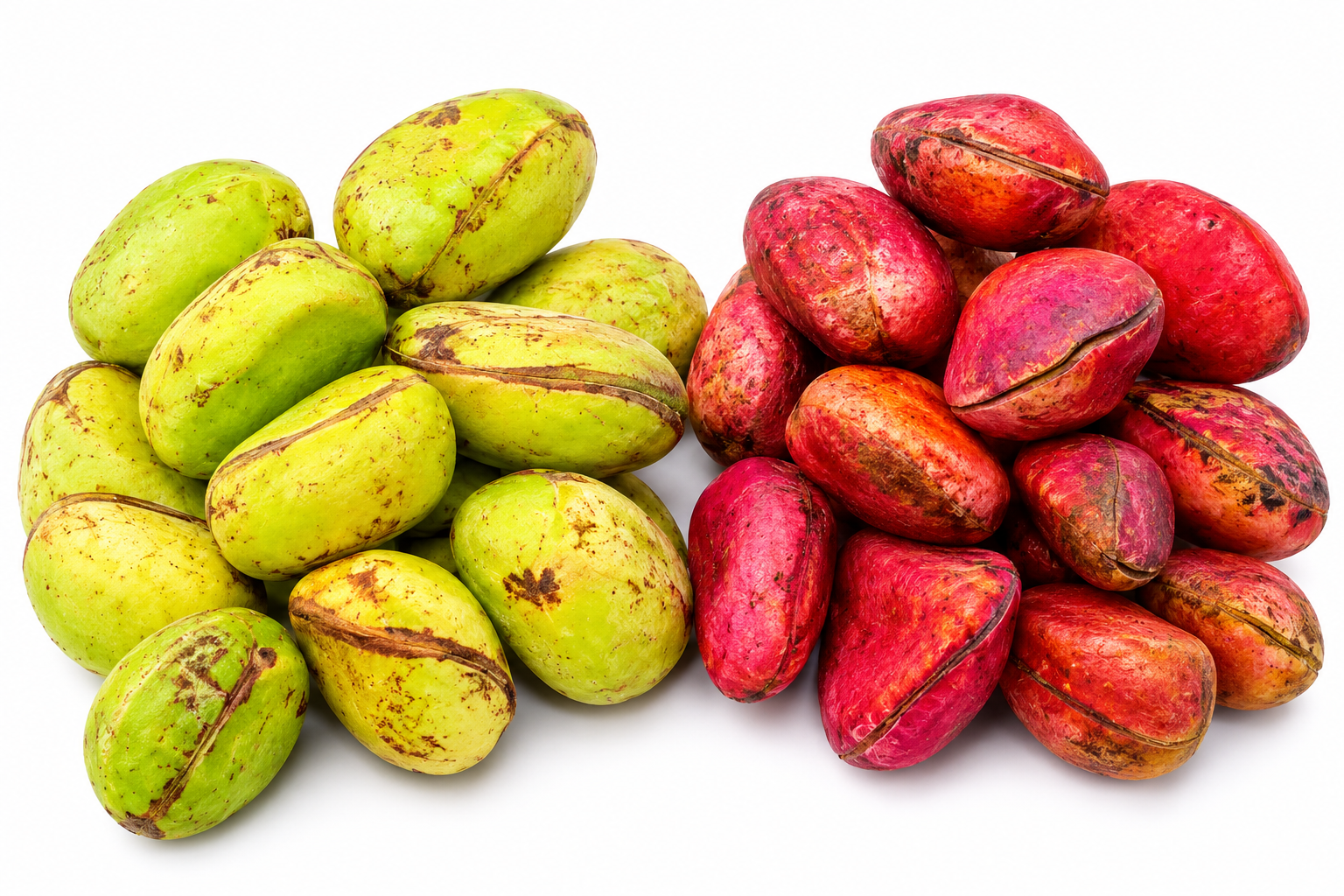
The tree produces large green follicles containing seeds commonly referred to as kola nuts.
These seeds occur in different natural colours, predominantly:
White.
Pink.
Red.
The seeds are traditionally consumed fresh or after curing and are deeply embedded in West African social, cultural and commercial practices.
Kola has historically been exchanged during ceremonies, presented to guests, used in traditional hospitality and traded as an important agricultural commodity.
However, its significance extends beyond cultural consumption. Its naturally occurring chemical constituents have attracted interest from food scientists, pharmacognosists, ingredient manufacturers and botanical researchers.
Botanical classification
ClassificationDescriptionScientific nameCola nitidaBotanical authority(Vent.) Schott & Endl.FamilyMalvaceaeGenusColaCommon nameKola nutOriginWest AfricaCommercial partSeedsSeed coloursWhite, pink and redPlant typeEvergreen tropical tree
Important botanical distinction: Cola nitida should not be confused with Garcinia kola, commonly called bitter kola. They are separate botanical species with different chemical compositions and applications.
02. PHYTOCHEMICAL COMPOSITION & NATURAL CONSTITUENTS
One of the most interesting characteristics of Cola nitida is its naturally occurring phytochemical composition.
Scientific investigations have identified several classes of compounds within the seeds, including alkaloids, flavonoids, tannins and other polyphenolic constituents.
Important naturally occurring compounds include:
CompoundChemical classIndustrial relevanceCaffeineMethylxanthine alkaloidNatural stimulant ingredientTheobromineMethylxanthine alkaloidFood and botanical ingredient researchCatechinFlavan-3-olPolyphenol and antioxidant researchEpicatechinFlavan-3-olPolyphenol and botanical extractionProcyanidinsPolyphenolsAntioxidant and functional ingredient researchTanninsPolyphenolic compoundsBotanical and extract applicationsFlavonoidsPlant secondary metabolitesNatural ingredient researchSaponinsGlycosidesPhytochemical research
The presence and concentration of these compounds can vary according to genetic material, growing conditions, maturity, geographical origin and post-harvest treatment.
For industrial buyers, this creates an opportunity to explore kola not only as a whole seed but also as a source of identifiable natural compounds.
03. WHY COLA NITIDA MATTERS TO INDUSTRY
Kola has a long history of human consumption, but its potential as an industrial ingredient extends into several areas.
A. NATURAL CAFFEINE SOURCE
Cola nitida naturally contains caffeine, a methylxanthine compound associated with central nervous system stimulation.
Historically, kola extracts were used in the development of cola-flavoured beverages and other stimulant-containing preparations.
Its caffeine content makes the seed relevant to research and industrial exploration involving natural caffeine sources.
B. THEOBROMINE CONTENT
Theobromine is another naturally occurring methylxanthine found in kola seeds.
It is also present in cocoa and has attracted interest in food chemistry, ingredient formulation and nutritional research.
C. POLYPHENOLIC COMPOUNDS
Catechin, epicatechin, procyanidins and other phenolic constituents have been reported in Cola nitida.
These compounds are of interest to manufacturers developing botanical extracts, polyphenol-rich ingredients and natural antioxidant formulations.
D. BOTANICAL EXTRACT DEVELOPMENT
The seed provides a starting material for investigating extraction methods that recover selected alkaloids and polyphenolic compounds.
Extraction conditions can be adapted to the target constituent and intended application.
E. FOOD & BEVERAGE INGREDIENTS
Kola has historical applications in beverages and food formulations.
Potential areas of industrial interest include natural flavour systems, botanical beverages, confectionery and specialised ingredient formulations.
04. RESEARCH FINDINGS & SCIENTIFIC INTEREST
Research into Cola nitida has progressed beyond its traditional use as a chewing nut.
Scientific literature has investigated its phytochemical composition, nutritional properties, biological activities, post-harvest characteristics and agricultural management.
Some particularly relevant findings include:
1. IDENTIFICATION OF BIOACTIVE COMPOUNDS
Phytochemical studies have identified caffeine, theobromine, catechin, epicatechin, tannins and other secondary metabolites.
These findings support further investigation of Cola nitida as a botanical extraction resource.
2. ANTIOXIDANT ACTIVITY
Laboratory investigations have reported antioxidant activity in kola extracts.
This is associated with the presence of phenolic compounds and flavonoids.
The findings are relevant to research into natural antioxidant ingredients, although laboratory activity does not automatically establish efficacy in humans.
3. ANTIMICROBIAL RESEARCH
Extracts from Cola nitida have demonstrated antimicrobial activity in certain experimental investigations.
These findings provide a basis for further research into its bioactive constituents.
They should not be interpreted as proof of clinical effectiveness or as a substitute for established antimicrobial treatments.
4. PHARMACOLOGICAL INVESTIGATIONS
Research reviews have documented investigations into potential anti-inflammatory, antidiabetic, antimalarial and other pharmacological activities.
Much of this evidence comes from laboratory and animal studies. Further controlled human research is required before therapeutic claims can be established.
5. POST-HARVEST CHEMICAL CHANGES
Research conducted on kola nuts from selected growing regions in Ghana found that curing and moisture reduction influenced measured chemical characteristics.
The study reported increased total polyphenol content in cured samples compared with fresh nuts.
It also identified mould contamination as an important post-harvest quality and food-safety concern.
This makes harvesting, curing, drying, storage and microbiological monitoring particularly important when developing kola for international industrial applications.
6. AGRICULTURAL AND COMMERCIAL IMPORTANCE
A 2024 systematic review examining three decades of Cola nitida research retained 280 scientific publications.
The review covered the species' socioeconomic importance, chemical and nutritional properties, propagation, pest management, genetic diversity and conservation.
It also identified opportunities for improving cultivation systems and the resilience of kola production.
These findings reinforce the importance of developing better organised agricultural sourcing and post-harvest infrastructure.
05. AGRICULTURAL SOURCING & PRODUCER NETWORKS
Woatome approaches Cola nitida as an agricultural commodity requiring organised sourcing, appropriate handling and quality management.
Our sourcing model is designed to connect existing kola-growing communities and producers with commercial buyers requiring consistent supplies.
The sourcing framework includes:
Identification of kola-producing communities.
Producer and farm-level engagement.
Botanical identification and species verification.
Assessment of available harvest volumes.
Harvest scheduling and collection coordination.
Producer handling guidelines.
Collection-point inspection and documentation.
Batch identification and traceability.
The objective is to establish a dependable agricultural sourcing network capable of supporting both immediate commercial procurement and longer-term supply development.
06. POST-HARVEST PROCESSING & QUALITY MANAGEMENT
Kola nut quality is significantly influenced by what happens after harvesting.
Freshly harvested seeds contain substantial moisture and require appropriate post-harvest management to preserve their quality.
Poor handling and storage conditions can encourage mould growth and compromise the suitability of the material for industrial applications.
Our processing framework focuses on:
Harvest reception and preliminary inspection.
Removal of unsuitable or damaged material.
Cleaning and preparation.
Controlled curing or drying, depending on the required product.
Moisture monitoring.
Sorting and grading.
Foreign-material inspection.
Microbiological quality assessment.
Appropriate packaging.
Controlled storage and dispatch.
Processing parameters are established according to whether the buyer requires fresh, cured or dried kola nuts, or material intended for further extraction.
07. PRODUCT FORMS & INDUSTRIAL APPLICATIONS
Cola nitida can enter several industrial supply channels depending on its processing condition and the buyer's intended application.
Product formPotential applicationFresh whole kola nutsTraditional consumption and further processingCured whole kola nutsFood ingredient and commercial kola marketsDried kola nutsBotanical and industrial ingredient processingCleaned and graded seedsBulk ingredient manufacturingKola seed piecesExtraction and formulationKola seed powderBotanical and food ingredient developmentKola seed extractsAlkaloid and polyphenol research and ingredient applications
Potential buyer industries
Food and beverage manufacturing.
Botanical extract manufacturers.
Natural ingredient processors.
Nutraceutical ingredient development.
Phytochemical research laboratories.
Natural stimulant ingredient manufacturers.
Agricultural ingredient traders.
Finished extracts and specialised ingredients require additional processing, characterisation and regulatory compliance. Woatome's bulk agricultural supply offering is focused on providing appropriately prepared raw material for these downstream activities.
08. PRODUCT SPECIFICATIONS & QUALITY PARAMETERS
Our objective is to develop commercially useful specifications that allow buyers to assess kola nuts against their intended processing requirements.
ParameterSpecificationBotanical identityCola nitidaCountry of originGhanaMaterialKola seedsNatural seed coloursWhite, pink and redPhysical formFresh, cured or driedMoisture contentAccording to buyer specificationPhysical conditionSound, appropriately handled seedsForeign matterControlled to agreed limitsMould contaminationSubject to inspection and testingMicrobiological qualityAccording to buyer requirementsCaffeine contentAvailable through laboratory analysisPolyphenolic profileAvailable through appropriate analytical testingPackagingFood-grade bulk packagingSupply formatCommercial bulk quantities
For buyers interested in extraction, we encourage specifications that identify the target constituent, analytical method and acceptable concentration range.
This allows sourcing and processing parameters to be aligned with actual industrial requirements.
09. QUALITY ASSURANCE, TESTING & TRACEABILITY
Industrial kola procurement requires more than visual inspection.
Woatome's quality management approach recognises the importance of botanical identity, post-harvest handling, moisture control, microbiological safety and chemical characterisation.
Depending on the product and destination-market requirements, supporting documentation may include:
Botanical identification records.
Product specification sheets.
Moisture analysis.
Caffeine quantification.
Theobromine quantification.
Total polyphenol analysis.
Catechin and epicatechin profiling.
Microbiological test results.
Mycotoxin analysis, where required.
Pesticide residue analysis.
Heavy metal analysis.
Batch and collection records.
Processing and storage documentation.
Export and shipment documentation.
Our objective is to develop a traceable connection between agricultural origin, collection, post-harvest processing and the final supplied material.
10. BULK SUPPLY & COMMERCIAL PROCUREMENT
Woatome welcomes enquiries from international buyers seeking Ghanaian Cola nitida for direct consumption, further processing, extraction or ingredient development.
Our commercial sourcing model can accommodate discussions around:
Whole kola nut procurement.
Fresh or cured kola requirements.
Dried kola seed supply.
Selected seed colours.
Buyer-specific grading requirements.
Extraction-oriented raw material specifications.
Seasonal procurement arrangements.
Bulk commercial quantities.
Long-term agricultural sourcing partnerships.
Supply volumes, processing formats, technical specifications and commercial terms are established according to seasonal availability and buyer requirements.
REQUEST BULK SUPPLY
SOURCE WEST AFRICAN COLA NITIDA
An indigenous West African agricultural resource with established traditional importance and growing relevance to modern ingredient research.
Woatome Micro Innovations works to organise the agricultural sourcing, post-harvest management and commercial supply infrastructure needed to connect this crop with international industrial markets.
If your business requires Cola nitida for food manufacturing, botanical extraction, ingredient development or scientific research, we invite you to discuss your procurement requirements with our sourcing team.
BULK SUPPLY ENQUIRIES
Please provide:
Company name and destination country.
Required product form.
Estimated procurement quantity.
Preferred seed colour, if applicable.
Intended industrial application.
Required chemical or microbiological specifications.
Preferred packaging.
Expected procurement period.
WOATOME MICRO INNOVATIONS
Agricultural Sourcing | Processing | Quality Management | Export Supply
Developing structured supply chains for valuable agricultural resources from Ghana and beyond.